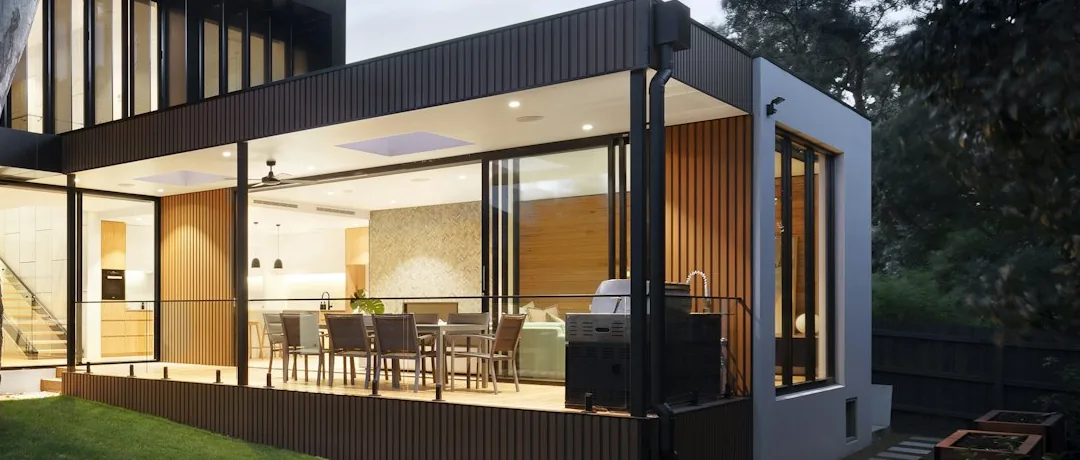
Outdoor Kitchens
Outdoor Kitchen Planning Checklist
Nearly every regret traces back to a decision that got made late. This is the order to make them in.
The order is the whole point
An outdoor kitchen is the one element in a yard where sequence punishes you hardest. Everything else can, at a push, be added later; a run of cabinetry with gas, water, drainage and power under it cannot, because all four of those things want to be in the ground before the paving that surrounds them.
So this checklist is ordered rather than grouped. Work down it. By the time you reach the appliances — which is where most people start — the difficult decisions are already made and the appliance conversation takes twenty minutes instead of three weeks.
1. Decide what kind of cook you are
Not aspirationally. Actually. There are broadly three outdoor kitchens people build, and they are not the same project:
- The grill station. A built-in grill, a working surface either side of it, and storage underneath. Cooking happens out here; preparation and washing happen inside. This is the one most households actually use.
- The serving kitchen. Grill plus refrigeration and a sink, so drinks and cold food do not require a trip indoors. The point of this one is fewer journeys, not more cooking.
- The full outdoor kitchen. Multiple cooking appliances, refrigeration, sink, dishwasher, generous counter. A genuine second kitchen, with a services requirement to match.
Be honest here and the rest of the list gets easier. Most disappointment comes from building the third while cooking like the first.
2. Fix the position, and check it against four things
Position drives services, and services drive cost and sequence. Before falling in love with a spot, walk it against these:
- Smoke. Where does it go on a normal evening breeze? Into the seating area, through a window, or over the neighbour's boundary are all answers you would rather discover now.
- Distance from the house. Every foot further out is more trench for services and a longer walk carrying things. There is a reason most successful outdoor kitchens sit close to the door.
- The cook's position. If the cook faces a wall while everyone else faces the pool, the kitchen will be used less than you expect. Orientation is a social decision as much as a practical one.
- Cover. A cooking area with no shade is a dawn-and-dusk facility for much of the year, and anything with electronics in it does better out of direct rain.
3. Settle the services while the ground is open
This is the irreversible step and it belongs before paving, not after. Four runs to consider:
- Gas, where a gas appliance is planned — including one that is not being fitted yet. A capped stub costs very little now.
- Water, if there is a sink, and with it a plan for where the waste goes rather than an assumption.
- Power, for refrigeration, lighting, ventilation and the outlets nobody plans and everybody wants.
- Drainage, both for the surface around the run and for the cabinetry, which needs water that gets into it to have somewhere to leave.
Even for a later phase, put the sleeve in. Cutting a finished terrace open to reach a line you decided against three years ago is the single most avoidable expense in this whole category.
4. Choose appliances by cut-out dimension, not by brand
Cabinetry is built to the openings the appliances need. That means the sizes have to be known before anything is fabricated, and it means you are effectively choosing appliances at design stage whether or not you have thought of it that way.
Work in terms of type and dimension: a grill of a given width, a refrigeration unit of a given cut-out, a sink of a given bowl size. We do not recommend particular manufacturers on this site, and any performance figures belong to the maker's own documentation rather than to a contractor's page. What matters here is that the numbers are fixed early and that they are the real ones from the specification sheet.
5. Plan the counter around the tasks, not the length
Counter space fails in a predictable way: there is plenty of it in total, and none of it where it is needed. Three zones are worth protecting individually — landing space beside the grill for what comes off it, a preparation area that is not also the serving area, and somewhere for people to put a drink down that is not the cooking surface.
A shorter run with those three protected beats a longer one without them, and it costs less.
6. Decide what the weather is allowed to reach
Outdoor cabinetry lives in sun, humidity, wind-driven rain and — near the coast — salt air. Materials and hardware get chosen against that, and the closer you are to the water the more the metal parts matter. Doors, drawer runners, hinges and fasteners are where an outdoor kitchen shows its age first.
Cover changes this considerably, which is why the shade decision and the kitchen decision are really one decision.
7. Ask about approvals early, and expect a careful answer
Work involving gas, electrical or plumbing runs is regulated, and what is required depends on your jurisdiction and on the scope of the project. Requirements vary, they are not the same in neighbouring municipalities, and they change — so treat any contractor who tells you confidently that a kitchen does or does not need approvals, without having looked at your address and scope, as guessing.
The right answer is that the requirements will be confirmed with the authority that reviews the work, as part of the project, before anything is committed. Where a community association is involved, that is a separate approval running on its own timetable.
8. Then, last, choose how it looks
Door fronts, counter material and the finish of the surrounding paving are the enjoyable part, and putting them last is not a demotion — it is what makes them a free choice. By this point the position, the services, the appliance dimensions and the cover are settled, so nothing you pick here can force a change to any of them.
One practical note: the counter is an outdoor horizontal surface in strong sun, so treat colour and heat the same way you would on a pool deck. A dark stone counter in full afternoon sun is unusable at exactly the hours you want to be out there.
Learned the hard way
Six things people wish they had done differently
Built for the party, not the Tuesday
Kitchens sized for an occasional gathering get used at the scale of a weeknight. Size for the weeknight and the gathering still works; the reverse does not.
Put it too far from the door
Distance is paid twice — once in trenching, and every evening afterwards in the walk back for the thing you forgot.
Skipped the sleeve
The gas or water run that was "probably not needed" is the one that later requires a finished terrace to be opened up.
No landing space beside the grill
Hot food has to go somewhere immediately. A run without that space is unpleasant to cook on regardless of how good the grill is.
Underestimated the sun
An uncovered kitchen on a west-facing terrace is a beautiful object you use at seven in the evening. Cover changes that more than any appliance.
Left lighting until the end
People cook outdoors after dark. Task lighting over the working surface needs a cable, and the cable needs to be in before the paving.
Where the position question gets hardest
On the larger rear yards in Parkland there is room to put a kitchen well away from the house, which makes the services trench and the evening walk the deciding factors rather than the space available. On compact coastal lots in Fort Lauderdale the constraint is reversed: there is one sensible position and the question is how much run fits into it. And in Weston, where a community approval usually sits alongside the municipal one, anything visible above fence height is worth raising at the very start.
Work through the list with someone on site
Position, smoke, services and cover are all easier to settle standing in the yard than on paper. A free consultation gets the first seven items answered in one visit.